Life · AI in the house
Claudia's Corner
The Family Harness
Before this, AI in my house looked like most houses in 2026. It didn't exist. Sure, I had a list of technical AI tools, as befits an engineer of my stature:
- Ollama on my Mac
- Azure AI Foundry deployment
- Claude subscription
- Gemini subscription
Four accounts, four logins, nothing the children could use without borrowing a parent's phone or computer, and no idea what any of it cost, no real hands-on time, no discovery.
To bridge all of this and give the family a tool, I decided to create a platform: the Family Harness. I framed it around the following:
- One door. A single web page on the home network that anyone in the house can open and just ask.
- Cheap by default. Most questions in a house are small. They should run on the free models on the Mac and only reach a paid model when it earns it.
- Safe for the kids and safe for the house. The children should not be able to reach the expensive models, adult topics, or, once the assistant could work the hoses, anything that costs water.
The result is Claudia's Corner, named after our older child. It has been the family's chat app since 22 September. In its first week it produced a study guide for a sixth-grade test on Mesopotamia, graphics for a Girl Scout fundraiser, a review of a PTA document, and a run of pictures of a small boy as a superhero. Everyone reached it from their own laptop or iPad, on the house network, with no account and no subscription of their own. Everything about it runs on a Raspberry Pi in the house, the same small board that runs the family file share and the house's landing page, which the family calls SHANE. No model runs on the Pi; the models live on my Mac and in the cloud, and the Pi's job is to decide which one to ask. The systems work was done by an AI operator working from my briefs, and I read every change.
Access
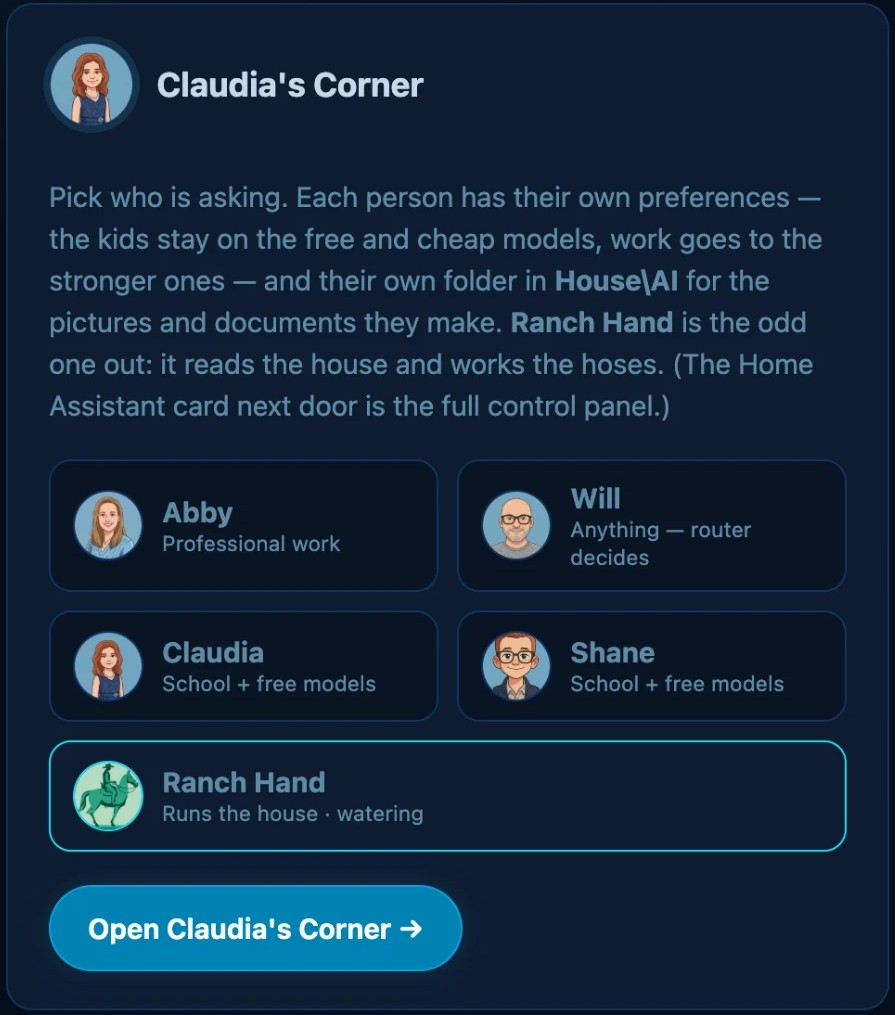
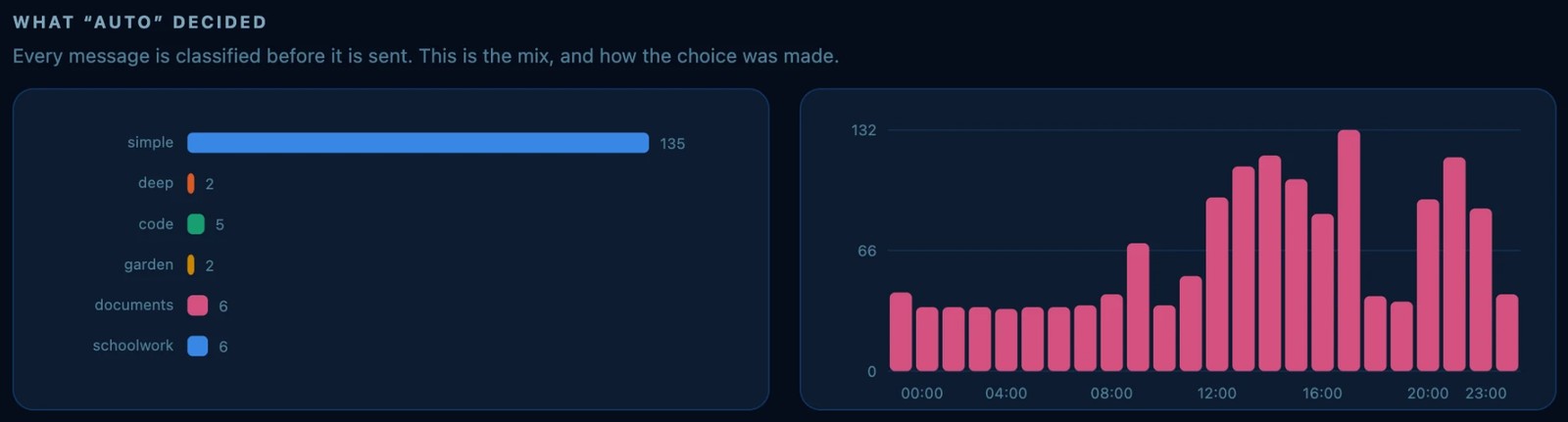
Someone on the home network opens the page and picks their face. This can be from an iPad, from a laptop, from an iPhone, it just has to be on the home network. Their message goes to a small router on the Pi that classifies it into one of six categories: simple, code, schoolwork, documents, deep, or garden. Heuristics run first; then the free local model gives a one-word classification with paid fallbacks disabled, so classifying can never cost money. The router picks a model for that category and that person, and passes the message to a gateway that fronts every model the house can reach: three local ones on my Mac over Tailscale, and Claude, Gemini and Azure in the cloud.
No model runs on the Pi. It has 4 GB of RAM and its job is to decide and route.
Base logic of routing
| category | default | Abby | the kids | Ranch Hand |
|---|---|---|---|---|
| simple, everyday questions | local, free | Gemini | local, free | local, free |
| code | local, free | Claude | local, free | local, free |
| schoolwork | Gemini | Gemini | Gemini | local, free |
| documents | Claude | Claude | Gemini | local, free |
| deep reasoning | Claude | Claude | Gemini | Gemini |
| garden | Gemini | Gemini | Gemini | Gemini |
The children never reach the most expensive models yet. I am trying to see how useful the cheaper and free models are. My wife's professional writing needs can, depending on the complexity. Ranch Hand, the profile that talks to the house and manages it, stays local for everything except genuinely hard reasoning, because its questions are lookups.
The garden category is an interesting example. It exists because the local model, asked which tulip varieties suit the yard, invented several, one of them a rose, and never noticed or looked up if we were in the right zone. I had to give it Gemini access to go out beyond the network and validate the "hallucinated truths" it kept coming up with. The garden questions cost about a tenth of a cent. There will be another article on the house and lawn management coming soon.
There is no login on the chat app. I track the analytics and usage, and there is a monthly cap of $25 in API cost. I could possibly go cheaper but haven't found the need yet.
The Harness Tools
Three, all short Python files. A documents tool that writes a Word file from markdown into that person's folder on the family share. A playbooks tool that reads plain markdown files anyone in the family can edit; the rules the assistants follow are text the family can correct. And the house tool, which only Ranch Hand gets.
Power is supplied through a Ubiquiti power strip. One of the cooler aspects of this is that the multiple device gateways needed for the overall stack are on their own plugs, and the harness itself can self-diagnose and "reboot" when there are stability issues.
Measuring as a study
Three pages sit on top of the gateway's spend log and the router's decision log: calls, cost, tokens and latency per model; spend per day and the local-versus-cloud split; and a per-person view, because every routing decision is stamped with the profile that asked.
The routing was decided by an experiment, not a preference. I took a real thread, a sixth-grader's Mesopotamia study guide built from seven notebook photographs, and re-ran it through the other models, each fed its own previous answers.
| model | cost | result |
|---|---|---|
| Claude Sonnet, what actually ran | $0.353 | the baseline |
| Claude Haiku | $0.077 | a concise outline |
| Gemini Flash | $0.071 | two and a half times the detail, and it quoted her own memory trick back to her |
| local vision model | free | too slow for a school night |
That is why schoolwork routes to Gemini.
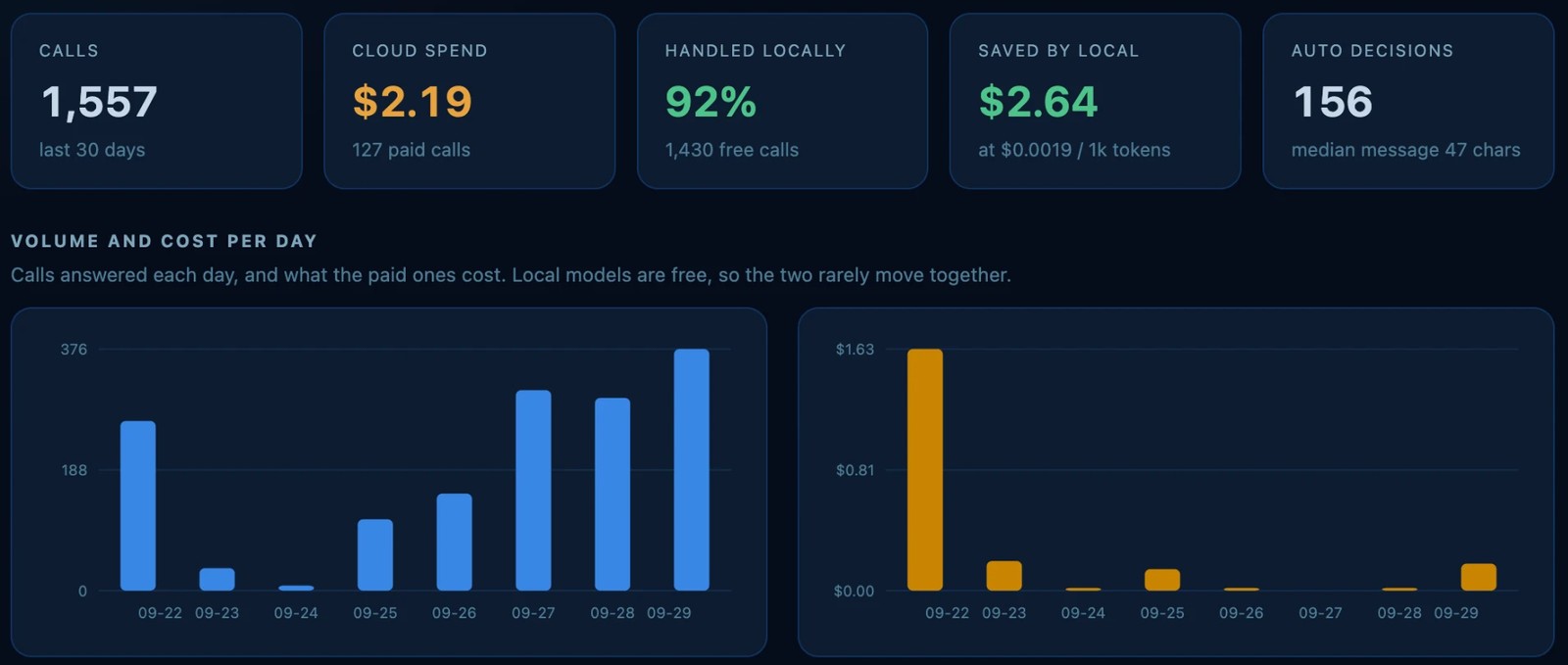
Where it stands on 29 September, eight days in: 1,557 calls, $2.19 in total. 1,430 of them, 92 percent, ran on the Mac for nothing. By day: $1.63 on the first day, when everything was being tested on Claude, then 20 cents, a penny, 14 cents, and never more than about 20 cents a day since.
Words by Will Mason. Every number was read from the running system. Built with an AI operator from my briefs.